
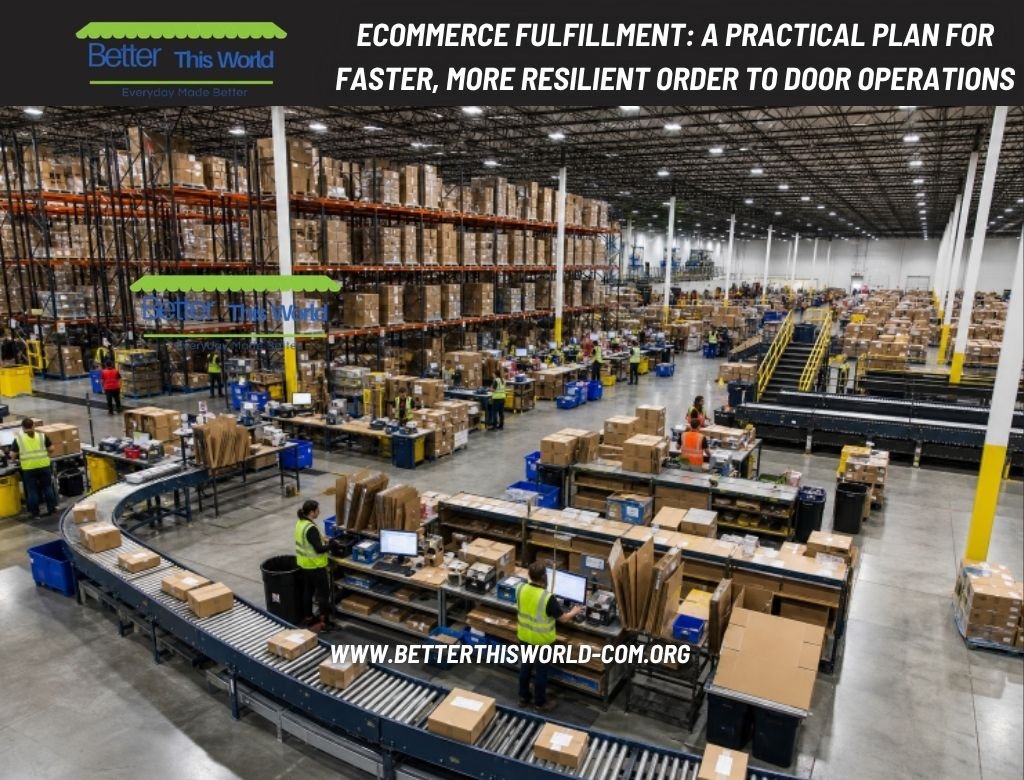
- Fast, dependable delivery begins with accurate inventory and clear order priorities.
- Flexible fulfillment networks can help retailers respond to growth, disruptions, and seasonal swings.
- Automation delivers the most value when it removes a known process bottleneck.
- Tracking, delivery communication, and returns are essential parts of the customer experience.
- A balanced set of metrics is more useful than measuring shipping speed alone.
Strong ecommerce fulfillment is the work of getting the right product to the right customer, in the right condition, within a delivery window that the operation can realistically meet. It connects inventory planning, warehouse execution, carrier management, customer communication, and returns.
For online retailers, fulfillment is not simply a back-office task. A stockout, an incorrect shipment, a delayed tracking update, or a difficult return can directly affect whether a shopper feels confident about placing another order.
Why Fulfillment Deserves More Attention
As order volume grows, small process gaps become more visible. A missed inventory update can lead to an oversold item. A poorly organized pick path can slow the warehouse. An unclear delivery promise can create avoidable customer service contacts.
The goal is not to build the most complicated operation. It is to create a repeatable system with clear ownership, reliable data, and sufficient flexibility to handle both normal demand and exceptions.
Recent U.S. retail e-commerce sales data illustrate the scale of the market: the Census Bureau estimated seasonally adjusted e-commerce sales at $340.2 billion in the second quarter of 2026, representing 17.1 percent of total retail sales. For retailers, that scale reinforces the need to treat fulfillment capacity and customer experience as connected priorities.
Start With a Clear Order-to-Door Map
Before changing software, adding labor, or redesigning storage, map every step an order takes:
- Order placement and payment approval
- Inventory allocation
- Picking, packing, and quality checks
- Carrier handoff and tracking
- Delivery, returns, or exchanges
This exercise reveals delays, duplicated work, and unclear handoffs. For example, a retailer may accept an order from a marketplace because the listing shows stock is available, even though the warehouse system has not yet reflected a recent sale. The order then waits for replenishment, even though the customer received a shipping estimate at checkout.
Build Inventory Visibility Before Adding Speed
Accurate inventory is the foundation for accurate promises. Connect the storefront, marketplaces, warehouse system, and customer service tools so teams can work from the same view of available stock.
Focus on frequent sources of error: misplaced products, delayed receiving, incomplete cycle counts, damaged goods left in available inventory, and inconsistent product identifiers. Set alerts for fast-moving items, low-stock thresholds, and seasonal products that may require earlier replenishment decisions.
Choose the Right Fulfillment Network
There is no single network model that fits every retailer. The right approach depends on order volume, catalog complexity, product dimensions, delivery zones, return rates, and expected growth.
- Centralized fulfillment can be easier to manage and may suit a smaller catalog or concentrated customer base.
- Regional fulfillment places inventory closer to major markets and can reduce shipping distance, but requires more coordinated replenishment.
- Distributed fulfillment can support faster delivery across broader geographies, although it increases the need for disciplined forecasting and inventory controls.
Use Automation Where It Removes Friction
Automation should address a specific, measurable problem. Useful starting points include barcode scanning during receiving and picking, automated order routing, shipping tools that compare service options, demand-based warehouse slotting, replenishment alerts, and automated tracking notifications.
Technology does not eliminate the need for judgment. Teams still need clear procedures for damaged goods, address problems, unusual orders, carrier exceptions, and customer requests that fall outside standard rules.
Make Order Accuracy a Daily Metric
A fast shipment is not successful if it contains the wrong item, quantity, or address. Track order accuracy by sales channel, product group, shift, or warehouse area to identify patterns without immediately assigning blame.
A simple calculation is: accurate orders divided by total orders, multiplied by 100. Improve the result with scan verification, product images at pick locations, readable shelf labels, and reviews of whether errors stem from training, system data, or warehouse layout.
Set Delivery Promises the Operation Can Keep
Delivery estimates should account for inventory location, order cutoff times, handling capacity, carrier service, and destination. During holidays, severe weather, or high-volume events, revise customer-facing expectations before missed promises become widespread.
Retailers should also understand the requirements for advertised shipping time frames. Under the FTC rule, sellers need a reasonable basis for their shipping claims and must offer required delay options or refunds when they cannot ship as promised.
Treat Returns as Part of the Fulfillment Plan
Returns affect available inventory, labor planning, cash flow, and customer loyalty. Establish clear rules for inspection, restocking, refurbishment, resale, or disposal, then measure return reasons by product and channel.
Return data can uncover preventable issues. For instance, clearer sizing guidance, more complete product specifications, and accurate images may reduce returns caused by mismatched expectations.
Prepare for Peak Demand Before It Arrives
- Review performance from the prior peak period.
- Forecast demand by product and sales channel.
- Plan labor, packaging supplies, and carrier capacity.
- Stage high-volume inventory for easier picking.
- Test integrations, alerts, and escalation procedures.
Measure What Customers Actually Feel
Use a balanced scorecard that includes order accuracy, on-time shipment rate, order cycle time, inventory accuracy, cost per order, return processing time, delivery-related contacts, and perfect order rate. One number alone can hide a larger problem. Faster processing, for example, may increase costs or picking mistakes if the process is not ready.
Common Questions About Ecommerce Fulfillment
Is faster shipping always better?
Not necessarily. Customers benefit from speed, but dependable delivery, accurate orders, reasonable costs, and clear tracking are equally important to a sustainable operation.
When should a retailer consider a fulfillment partner?
Common signs include recurring stock errors, limited warehouse space, rising order volume, weak peak-season performance, or excessive internal time spent on shipping tasks rather than core business priorities.
What should a retailer automate first?
Start with repetitive tasks that frequently cause delays or errors, such as order imports, inventory updates, label creation, tracking messages, and replenishment alerts.
Conclusion: Build a Fulfillment System That Can Adapt
Resilient fulfillment is built through accurate data, practical workflows, realistic delivery promises, and regular performance reviews. Retailers do not need to chase every new tool. They need an order-to-door system that can manage daily demand, respond to disruption, and improve as customer expectations evolve.