

Modern Corporate Investigative Consulting in High-Stakes Cyber Threats
The digital world offers vast opportunities, but it also presents significant dangers. Cybercrime has become a global menace. It costs organizations billions of dollars annually. Reports show over $50 billion was lost to cybercrime from 2020 to 2024 alone. These attacks threaten a company’s finances, operations, and reputation.
Today’s cybercriminals are highly advanced. They exploit both human weaknesses and new technologies. This makes investigating cyber incidents incredibly complex. Businesses need robust defenses and proactive strategies. These help to identify, respond to, and prevent attacks.
We will explore the vital role of due diligence in corporate investigations. We’ll show how organizations can better protect themselves from evolving cyber threats. We will examine the methods used by experts, including digital forensics, intelligence gathering, and specialized investigative consulting and background checks. We will also highlight how private sector efforts work with law enforcement to dismantle criminal networks. Join us as we discuss crucial strategies for securing your digital assets in this challenging landscape of October 2026.
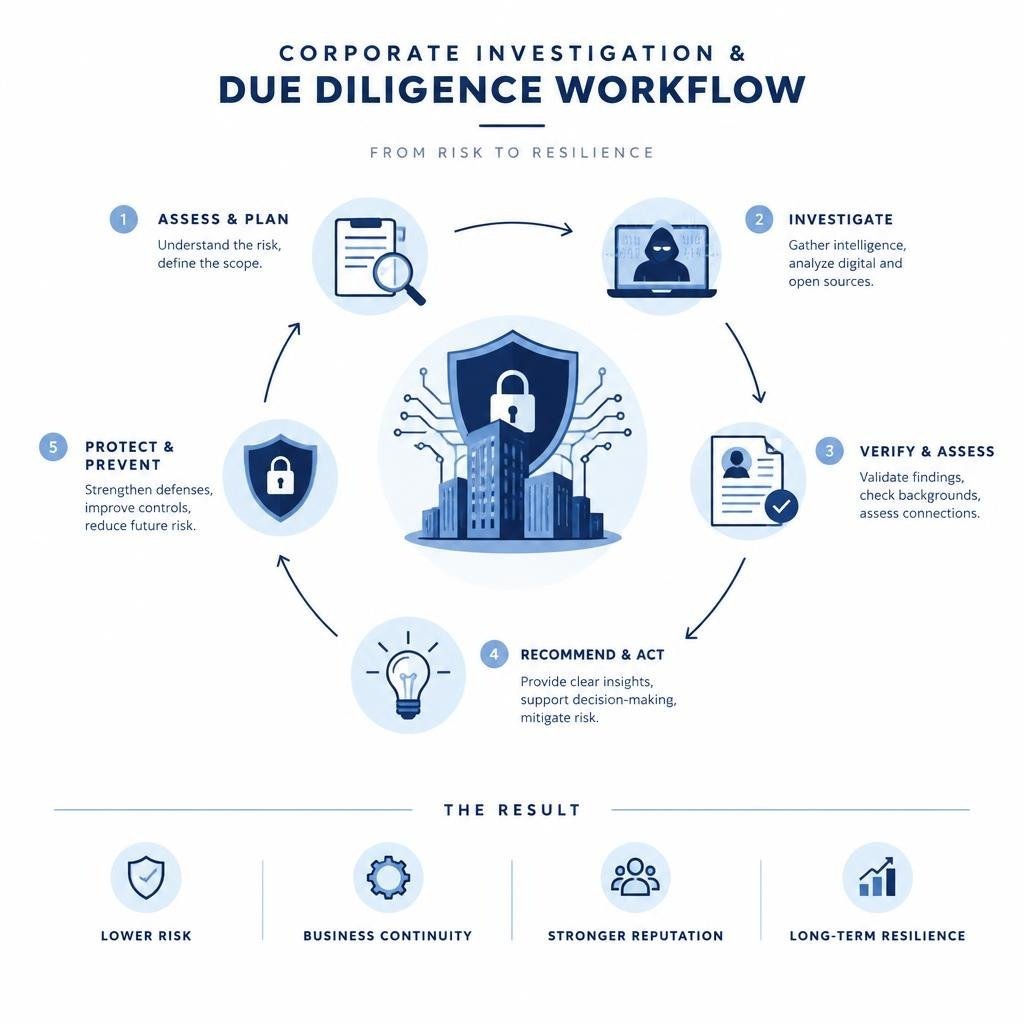
In October 2026, the landscape of cybercrime is more intricate and financially devastating than ever before. Cybercrime is no longer merely a nuisance; it has evolved into a sophisticated shadow economy, with annual losses now comparable to the gross domestic product of major economies.
Our approach to modern corporate investigative consulting focuses on building forensic readiness, ensuring that businesses are not only prepared to respond to an incident but also to gather admissible evidence. This involves understanding the intricate web of cybercrime operations, from ransomware groups to nation-state actors, and developing strategies to mitigate their impact.
The Evolving Global Threat Landscape and Financial Exposure
The financial toll of cybercrime is staggering. The Internet Crime Complaint Center (IC3) reported over $50 billion in losses between 2020 and 2024, a figure that only scratches the surface of the true economic impact. This “global underground economy” thrives on anonymity and cross-border operations, making threat profiling and attribution incredibly challenging. Ransomware, in particular, has seen exponential growth, with groups like KillSec linked to approximately 1,000 suspected attacks worldwide and 500 confirmed successful compromises since 2024. These attacks often involve financial extortion, paralyzing companies and demanding large cryptocurrency payments.
The accessibility of sophisticated hacking tools means that even smaller, less organized groups can pose significant threats.
Internal Enterprise Response vs. External Cyber Investigation Experts
| Feature | Internal Enterprise Response | External Cyber Investigation Experts |
|---|---|---|
| Expertise & Resources | Relies on in-house teams and available tools. | Offers specialized forensic tools and threat intelligence. |
| Objectivity | May face internal pressure or bias. | Provides an independent assessment. |
| Scalability | May struggle with complex incidents. | Can deploy additional experts as needed. |
| Legal & Regulatory | Focuses on internal policies and procedures. | Provides expertise in evidence handling and regulatory compliance. |
| Law Enforcement Liaison | May have limited agency contacts. | Can assist with coordination with relevant authorities. |
| Long-Term Cost Efficiency | Lower initial costs but potentially higher recovery expenses. | Higher initial costs but may reduce long-term losses. |
Core Methodologies in Corporate Investigative Consulting
Our methodologies are built on a foundation of rigorous digital forensics. This involves the meticulous collection, preservation, and analysis of electronic evidence in a manner that is legally admissible in court. Cyber Crime Investigators utilize a range of specialized tools, including disk analysis software, advanced data search utilities, network monitoring systems, and sophisticated data analysis platforms to reconstruct events, identify perpetrators, and understand attack vectors.
Beyond forensics, threat hunting is a proactive methodology where our experts actively search for signs of malicious activity that may have bypassed existing security controls.
Evidence preservation is paramount. Digital evidence is inherently volatile and can be easily altered or destroyed if not handled correctly. We adhere to strict chain of custody protocols to ensure the integrity and authenticity of all collected data. This process is vital for any potential legal action, whether it’s prosecuting cybercriminals or recovering assets.
Forensic Due Diligence and Evidence Handling in Cyber Extortion
Cyber extortion, particularly through ransomware, presents unique challenges for forensic due diligence and evidence handling. The moment an organization discovers a ransomware attack, a critical clock begins ticking.
Ransomware groups frequently leverage dark web leak sites to publish stolen data, adding immense pressure on victims to pay the ransom. This tactic transforms a technical incident into a public relations and reputational crisis.
Ransomware Ecosystems and Mass Data Seizures
The modern ransomware landscape is dominated by sophisticated Ransomware-as-a-Service (RaaS) models. In these ecosystems, core developers create the ransomware code and infrastructure, then recruit affiliates to carry out the actual attacks. Groups like KillSec exemplify this model, operating an extensive network that was linked to approximately 1,000 suspected attacks worldwide. These operations often involve mass data exfiltration, where vast quantities of sensitive information are stolen before encryption, serving as additional leverage for extortion.
Operation KillSwitch, a multinational law enforcement effort in October 2026, highlighted the scale of these operations by securing at least 110 terabytes of data from KillSec’s leak-site infrastructure.
Managing Attribution, Juvenile Offenders, and Emerging AI Risks
Attributing cyberattacks to specific actors, especially when they operate across borders, remains one of the most significant challenges in cybercrime investigation. Criminals skillfully use anonymizing technologies and infrastructure spread across multiple jurisdictions to obscure their identities. However, advanced forensic techniques and international intelligence sharing can often pierce through this veil.
A concerning trend is the increasing role of minors in sophisticated cybercrime. Operation KillSwitch, for instance, identified a 16-year-old as the suspected main operator and administrator of the KillSec ransomware group. This raises complex legal and ethical challenges regarding prosecution and rehabilitation, as these young offenders often possess advanced technical skills but may lack a full understanding of the consequences. The ShinyHunters group, known for claims of stealing 2 to 3 terabytes of data related to FBI workers, also illustrates how technically proficient individuals, regardless of age, can exploit vulnerabilities like those in Oracle PeopleSoft.
Adding another layer of complexity is the emergence of AI-driven cybercrime. KillSec reportedly used AI tools to develop ransomware and identify victims, showcasing how artificial intelligence can automate victim selection, exploit discovery, and infrastructure management.
Strategic Collaboration: Bridging Private Defense and Global Law Enforcement
The borderless nature of cybercrime necessitates a collaborative approach that transcends national boundaries and organizational silos. Strategic collaboration between the private sector and global law enforcement agencies is not merely beneficial; it is essential for effectively combating today’s digital threats. Agencies like the FBI and Europol’s European Cybercrime Centre (EC3) serve as central hubs for multi-jurisdictional coordination, sharing actionable intelligence with the private sector to mitigate threats.
The FBI, with its 56 field offices housing specially trained cyber squads and its 24/7 CyWatch operations center, actively engages victims and shares advisories and threat-hunting guidance.

Integrating Corporate Investigative Consulting with Law Enforcement Operations
Effective cybercrime investigation often hinges on the seamless integration of corporate investigative consulting with law enforcement operations. When a cyber incident occurs, prompt engagement with law enforcement is crucial. Agencies like the FBI operate rapid-response Cyber Action Teams that can deploy within hours, working alongside corporate forensic teams. The National Cyber Investigative Joint Task Force, comprising over 30 co-located agencies, exemplifies this integrated approach, pooling resources and expertise.
Our role as corporate investigative consultants involves ensuring that evidence collected during an incident response is gathered in a manner that meets evidentiary standards for law enforcement.
Cross-Border Legal Frameworks and Asset Recovery
The global reach of cybercrime means that investigations frequently encounter complex cross-border legal frameworks, particularly concerning extradition and asset recovery. The case of Fouad Eltibrizi, a Dutch national arrested in the UK and awaiting extradition to the US on federal cybercrime charges, illustrates these complexities. Such cases often involve international treaties, mutual legal assistance requests, and strategic venue choices for indictments, such as the Puerto Rico federal district used in Eltibrizi’s case.
Asset recovery, especially involving cryptocurrency, presents its own set of challenges due to the pseudonymous nature of digital currencies. However, agencies are increasingly sophisticated in tracing cryptocurrency transactions, and entities like the IC3 Recovery Asset Team have successfully frozen hundreds of thousands of dollars for victims.
Here are primary evidence preservation steps for corporate victims:
- Isolate Affected Systems: Disconnect compromised devices from the network to prevent further spread or data corruption.
- Do Not Alter Data: Avoid making changes to affected systems, even seemingly minor ones, as this can compromise evidence integrity.
- Image Drives and Memory: Create forensic images of hard drives and capture volatile memory (RAM) as quickly as possible.
- Collect Logs: Secure all relevant logs, including network, server, application, and security logs, from before, during, and after the incident.
- Document Everything: Maintain a detailed timeline of events, actions taken, and observations, including screenshots and timestamps.
- Preserve Physical Evidence: If applicable, secure physical devices involved, ensuring they are handled and stored properly.
- Secure Backup Data: Ensure that backups are isolated and protected from potential compromise, as they may be critical for recovery.
- Consult Legal Counsel: Engage legal counsel early to understand legal obligations and ensure all actions comply with relevant laws.
Frequently Asked Questions:
How do corporate investigations support law enforcement?
Corporate investigations help identify suspicious activity, preserve digital evidence, and document incidents. Properly handled evidence can support investigations by relevant authorities.
How does due diligence reduce ransomware risks?
Due diligence helps businesses identify vulnerabilities, assess third-party risks, review access controls, and improve security practices before incidents occur.
How are cross-border cybercrime cases investigated?
Authorities cooperate through applicable international agreements, evidence-sharing procedures, and legal assistance mechanisms. The process depends on the jurisdictions and circumstances involved.
Can stolen cryptocurrency be recovered?
Recovery may be possible, depending on the circumstances. Investigators can trace transactions and work with relevant service providers and authorities, but successful recovery is not guaranteed.
Conclusion
In October 2026, the battle against cybercrime is a relentless and evolving challenge, demanding constant vigilance and adaptability.
Strategic intelligence, derived from meticulous forensic diligence and proactive threat hunting, forms the bedrock of enterprise resilience. It is through comprehensive investigative consulting that organizations can not only respond effectively to incidents but also proactively identify and mitigate vulnerabilities.