
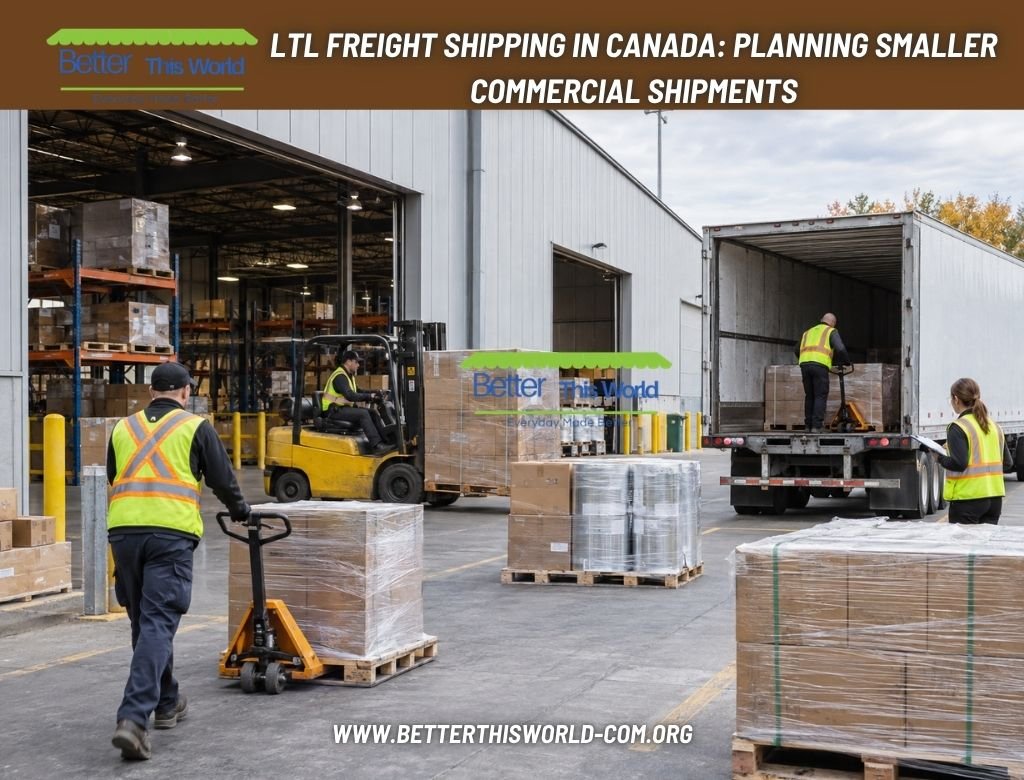
Canadian businesses frequently need to transport commercial goods without having enough freight to fill an entire truck. Manufacturers may ship replacement parts to distributors, wholesalers may replenish retail inventory, and businesses may move several pallets between regional facilities.
For these shipments, less-than-truckload (LTL) transportation provides an alternative to booking a dedicated trailer. Rather than paying for an entire truck, businesses share available trailer capacity with freight from other shippers.
Understanding how LTL freight in Canada operates can help businesses make informed decisions about shipment preparation, transportation costs, scheduling, and delivery requirements.
The most appropriate shipping arrangement depends on more than shipment weight. Freight dimensions, handling needs, delivery frequency, and operational flexibility all influence whether shared truck capacity is a practical choice.
How LTL Shipping Works for Commercial Freight
Less-than-truckload transportation combines shipments from multiple businesses into shared trailer space. Each shipper pays for the transportation of its freight based on applicable pricing factors rather than reserving the entire vehicle.
An LTL shipment commonly consists of one or several pallets, although the exact size and weight accepted depend on the transportation provider.
Freight may move through a network of terminals where shipments are consolidated, transferred, and organized according to their destinations. This process allows carriers to serve multiple customers along established transportation routes.
For Canadian businesses, LTL shipping can support several common requirements:
- Regular inventory replenishment between warehouses and retail locations.
- Small manufacturing shipments sent to customers or distributors.
- Palletized products moving between suppliers and commercial facilities.
- Regional shipments that do not justify dedicated truck capacity.
Businesses arranging commercial freight shipping between Toronto, Mississauga, Brampton, and other Ontario distribution centres may find shared transportation useful when shipment volumes fluctuate.
However, LTL freight typically involves more handling than direct full truckload transportation. Shipments may be loaded and unloaded at multiple facilities before reaching their destinations.
Fragile, oversized, or unusually sensitive cargo may therefore require additional evaluation before selecting this method.
Preparing Shipments for Efficient Transportation
Accurate shipment information is essential when arranging LTL transportation. Carriers and freight coordinators rely on cargo details to determine available capacity, handling requirements, and transportation charges.
The most important measurements include the shipment’s total weight, length, width, and height. For palletized cargo, dimensions should account for the complete loaded pallet, including packaging materials and any overhanging products.
Incorrect measurements can create problems during pickup, consolidation, and billing.
For example, a shipment described as occupying one standard pallet position may require additional trailer space if the cargo extends beyond the pallet edges. The difference can affect transportation pricing and capacity planning.
Packaging also deserves attention.
Products should be secured to prevent shifting during transportation. Depending on the cargo, businesses may use stretch wrapping, protective corner boards, strapping, or reinforced packaging.
Clear shipment labels and accurate shipping documentation help carriers identify cargo and confirm delivery instructions.
Businesses arranging pallet shipping in Canada should also consider whether receiving locations have loading docks, forklifts, or other equipment needed to unload freight safely.
Locations without suitable equipment may require liftgate service or other special arrangements, potentially affecting the final transportation cost.
Understanding Freight Consolidation, Scheduling, and Costs
Freight consolidation can improve transportation efficiency when businesses regularly move smaller quantities of goods.
Instead of sending several separate shipments over a short period, a company may combine compatible orders into a larger shipment when delivery requirements allow.
For example, a wholesaler supplying multiple orders to the same regional distribution facility might consolidate outgoing pallets into one scheduled movement.
This approach can reduce repeated pickup activity and simplify shipment administration. However, consolidation is not always appropriate when customers require immediate delivery or inventory availability is limited.
Scheduling is equally important.
Businesses should consider order processing times, warehouse operating hours, carrier pickup availability, and customer delivery windows. LTL networks may also involve terminal transfers, making transit planning particularly relevant for time-sensitive orders.
Several factors influence LTL shipping costs, including:
- Shipment weight and dimensions: Heavier or larger shipments may require more transportation capacity.
- Origin and destination: Distance, route availability, and service coverage influence pricing.
- Freight characteristics: Density, handling requirements, and applicable freight classification can affect rates.
- Additional services: Liftgate delivery, residential delivery, appointment scheduling, and other accessorial charges may increase costs.
- Shipment frequency: Recurring shipping patterns can create opportunities for more consistent transportation planning.
Businesses should evaluate the total delivered cost rather than comparing transportation rates alone.
A lower quoted rate may not represent the most economical arrangement if additional handling charges, longer transit times, or operational delays create downstream expenses.
Coordinating Recurring Shipments and Choosing the Right Freight Option
Businesses with predictable shipping volumes may be able to establish regular pickup schedules and standardized freight preparation procedures.
For companies with variable demand, transportation planning can be more complicated.
A manufacturer might ship two pallets one week and ten pallets the next. A wholesaler may experience seasonal inventory increases that change its transportation requirements.
In these situations, freight coordination providers can help businesses assess shipment characteristics, review available ground transportation arrangements, and coordinate movements according to changing requirements.
For example, Robin Transportation Systems Inc. is a Canadian freight forwarding company that coordinates ground transportation for commercial shipments. Businesses reviewing LTL and land freight services in Canada can consider how different transportation arrangements relate to shipment volume, scheduling, and handling requirements.
Working with a freight coordinator may be useful when businesses manage shipments across multiple destinations, have irregular freight volumes, or need assistance organizing carrier communications and delivery requirements.
However, LTL transportation is not suitable for every shipment.
Full truckload shipping may be preferable when freight occupies most of a trailer, requires direct movement, or involves cargo that should undergo minimal handling.
Smaller individual packages may be better suited to parcel transportation, while unusually large or specialized shipments could require dedicated equipment.
The decision should reflect shipment characteristics and operational priorities rather than shipment size alone.
For Canadian businesses, effective freight planning involves balancing transportation costs with delivery reliability, handling requirements, and inventory needs.
Maintaining accurate shipping records, monitoring recurring freight patterns, and reviewing transportation arrangements as volumes change can help businesses select practical shipping methods.
When shared trailer capacity aligns with shipment requirements, LTL freight offers a flexible approach to moving commercial goods without consistently committing to an entire truck.