

Core Principles of Industrial Processing and Measurement
At the heart of efficient industrial operations lie fundamental scientific principles: mass conservation and heat transfer. These govern every transformation of material and energy within a plant. To manage these complex interactions effectively, continuous monitoring is indispensable. Modern industrial processing relies on a robust interplay between these principles and sophisticated measurement techniques, ensuring that inputs are precisely converted into desired outputs with minimal waste. Sensors, the eyes and ears of industrial processes, must exhibit exceptional durability to withstand harsh operating conditions, from extreme temperatures and pressures to corrosive or abrasive media. Understanding fluid dynamics, including how liquids, gases, and slurries behave under various conditions, is also paramount for designing efficient processing systems and accurate measurement points.
Mass Flow, Density, and Viscosity Dynamics
Accurate measurement of mass flow, density, and viscosity is critical across nearly all industrial sectors, from petrochemicals to food and pharmaceuticals. Coriolis mass flowmeters, such as the OPTIMASS 7000, have become a cornerstone for this precision. These devices operate on the principle that a vibrating tube will experience a phase shift proportional to the mass flow of the fluid passing through it. A key innovation in some Coriolis designs is the single-tube architecture, which significantly reduces pressure loss compared to traditional dual-tube designs. This not only saves energy but also minimizes wear on pumps and other inline equipment.
Such meters deliver exceptional mass flow accuracy, typically around ±0.1% for liquids and ±0.35% for gases, providing reliable data for critical processes like custody transfer or precise ingredient dosing. Beyond mass flow, they simultaneously provide highly accurate density profiling (e.g., ±2 kg/m³ over a range of 400-2500 kg/m³), which is vital for quality control and process optimization. The ability to measure these parameters with minimal pressure loss and high repeatability makes them invaluable, even in challenging applications involving multiphase flow or highly viscous fluids.
Thermal Processing and Separation Units
Thermal processing and separation are fundamental operations in many industries, transforming raw materials into finished products or isolating valuable components. This category encompasses a wide array of technologies, including evaporation systems, which concentrate solutions by removing solvent, and distillation columns, which separate liquid mixtures based on differences in boiling points. Both processes are energy-intensive, making precise measurement and control crucial for operational efficiency.
Another vital area is moisture removal, often achieved through advanced thermal drying equipment. Whether it’s drying food products, chemicals, or minerals, the goal is to achieve a specific moisture content while minimizing energy consumption and preserving product integrity. Effective moisture measurement, discussed later, directly informs the control of these dryers, preventing over-drying and ensuring consistent quality. Techniques for latent heat recovery are increasingly integrated into these systems to improve overall energy efficiency, capturing heat from exhaust streams to pre-heat incoming materials or generate power. These units are designed to achieve precise phase separation, isolating solids from liquids, liquids from gases, or different liquid phases from one another, all of which depend on accurate temperature, pressure, and concentration measurements.
Real-Time Inline Analytical Technologies
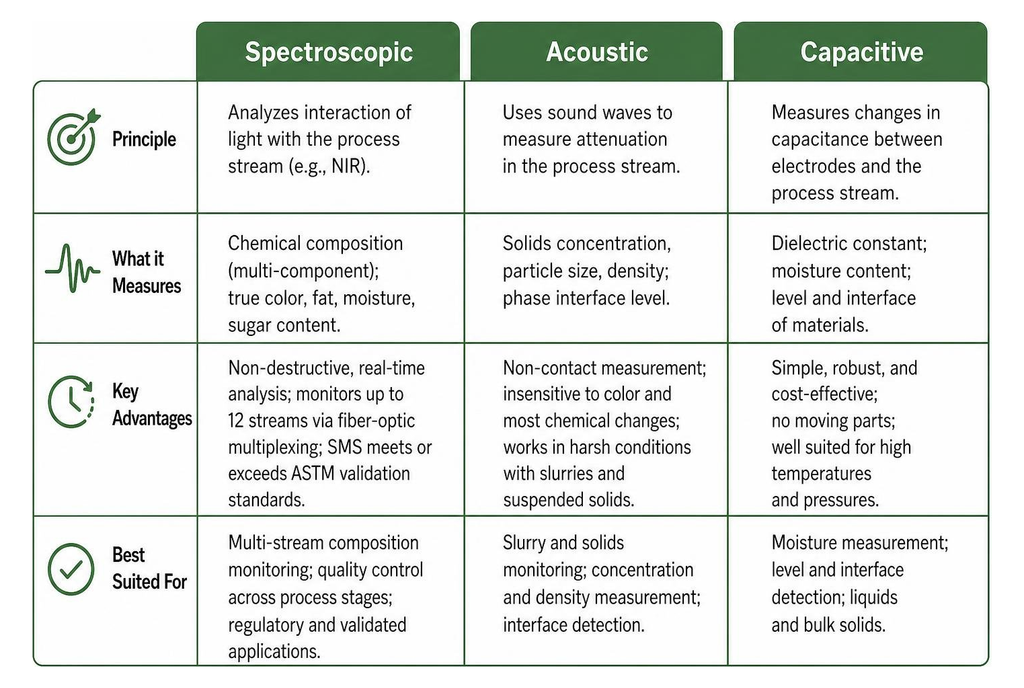
The shift from laboratory-based quality control to real-time inline analysis represents a paradigm change in industrial processing. This transition is driven by the need for immediate feedback, allowing for dynamic process adjustments that prevent material waste, reduce energy consumption, and ensure consistent product quality. Technologies like spectroscopic analysis, acoustic wave attenuation, and capacitive sensing are at the forefront of this revolution, providing continuous insights directly within the process stream. These inline quality control methods eliminate the delays associated with traditional sampling and lab testing, enabling proactive rather than reactive process management.
Spectroscopy and Multi-Stream Composition Monitoring
Near-infrared (NIR) spectroscopy has emerged as a powerful tool for non-destructive, real-time chemical composition profiling. NIR analyzers, such as the NIR-O process analyzer, operate in the 1000-2100 nm range, utilizing advanced TE-cooled InGaAs detector technology. A significant advantage of these systems is their ability to monitor multiple independent process streams or sample interface points—up to 12 in the case of the NIR-O—using fiber-optic multiplexing. This allows a single analyzer to oversee various stages of a complex process, from raw material inspection to final product quality checks.
These systems provide continuous, non-destructive testing, meaning samples are analyzed without being altered or removed from the process, making them ideal for monitoring sensitive or hazardous materials. Furthermore, many modern NIR analyzers incorporate features like Stability Monitoring Systems (SMS) that meet or exceed ASTM validation standards (e.g., ASTM D6122), ensuring data reliability and traceability for regulatory compliance. This capability is crucial for industries like pharmaceuticals, where strict validation protocols are mandatory. Beyond chemical composition, spectrometers like the ZEISS Corona® process can simultaneously measure true color values, fat, moisture, and sugar content, providing a comprehensive quality picture.
Ultrasonic Particle Sizing and Concentrated Slurries
For industries dealing with suspensions, emulsions, and slurries, understanding particle size distribution (PSD) is paramount for product performance and process efficiency. Traditional optical methods often struggle with opaque or highly concentrated media, requiring sample dilution that can alter the sample’s true state. Ultrasonic extinction sensors, such as the OPUS-BP, overcome these limitations by using acoustic wave attenuation. This technology emits sound waves through the process fluid; the degree to which these waves are attenuated correlates directly with particle size and concentration.
This allows for real-time particle size measurement from below 0.1 µm to 3,000 µm without any sample preparation or dilution, even in highly concentrated or opaque streams. The OPUS-BP sensor operates robustly across a wide range of conditions, tolerating product temperatures from -20°C to 120°C and pressures up to PN40. Its ability to provide continuous PSD data directly in the process line (DN50 to DN200) is invaluable for applications in mineral processing, chemical synthesis, and food production, where particle characteristics directly impact filtration, reactivity, and final product texture.
Bulk Solid Moisture and Permittivity Sensing
Moisture content is a critical quality parameter and a significant cost driver in the processing of bulk solids, affecting everything from product stability and flowability to energy consumption in drying processes. Capacitive moisture measurement offers a highly effective inline solution for these materials. Sensors like the HUMY 301 operate by generating an electromagnetic field and measuring the dielectric constant and high-frequency attenuation of the bulk material. Since water has a significantly different dielectric constant than most dry materials, its content can be accurately derived from the material’s permittivity.
A key advantage of capacitive sensing is its ability to penetrate deep into the material—up to 200 mm—providing a measurement of total water content rather than just surface moisture. This makes it superior to some surface-sensitive methods in certain applications. These systems are designed for robust industrial environments, capable of operating in ATEX zones (e.g., dust zone 20, gas zone 0) and at temperatures up to 120°C. With the capacity to store multiple calibration curves, they can handle various product types on a single line, enabling automatic product switching. Real-time moisture data directly feeds into process control systems, allowing for precise adjustments to dryers and mixers, optimizing product quality and significantly reducing energy use.
Bulk Material Handling and Supply Chain Logistics
The journey of materials through an industrial facility begins with raw material intake and extends through every stage of processing to final product dispatch. Efficient bulk material handling is foundational to operational success, and precise measurement plays a crucial role in optimizing every step. From ensuring accurate payload density in incoming shipments to managing extensive inventories, reliable data prevents losses and streamlines operations.
One area where precision measurement significantly impacts efficiency is in transport logistics. For operations dealing with large volumes of bulk materials, accurately assessing the volume and weight of incoming or outgoing loads is critical. Technologies like volumetric truck load scanning provide rapid, accurate, and non-contact measurement of material volumes in trucks, railcars, and stockpiles. This ensures that received quantities match ordered quantities, optimizes loading processes, and provides verifiable data for billing and inventory reconciliation.
Integrating Industrial Processing and Measurement into Modern Control Loops
The true power of advanced industrial processing and measurement is realized when these systems are seamlessly integrated into modern control loops. This integration transforms raw data into actionable intelligence, enabling automated decision-making and continuous optimization. Supervisory Control and Data Acquisition (SCADA) systems serve as the central nervous system, collecting data from myriad sensors and providing operators with a comprehensive overview of plant operations.
Communication protocols like OPC UA (Open Platform Communications Unified Architecture) facilitate secure, reliable, and interoperable data exchange between different devices, systems, and software applications, bridging the gap between field devices and enterprise-level systems. Programmable Logic Controllers (PLCs) act as the workhorses, executing control commands based on sensor feedback, such as adjusting valve positions or motor speeds. The rise of edge data processing means that initial data analysis and decision-making can occur closer to the source, reducing latency and bandwidth requirements, especially for critical, real-time adjustments. This enables automated setpoint correction, where process parameters are dynamically adjusted based on real-time measurements to maintain optimal conditions, minimize deviations, and improve overall product consistency.
Standards, Traceability, and Environmental Compliance
In an increasingly regulated and environmentally conscious world, adherence to standards, ensuring traceability, and achieving environmental compliance are non-negotiable aspects of industrial processing. International standards like ISO 9001 (Quality Management Systems) and ISO 14001 (Environmental Management Systems) provide frameworks for operational excellence and responsible manufacturing. By aligning processes with these standards, companies demonstrate a commitment to quality, efficiency, and sustainability.
The concept of digital product passports (DPPs) is gaining traction as a means to enhance traceability throughout the product lifecycle. These digital records provide comprehensive information about a product’s origin, materials, manufacturing processes, and environmental impact, supporting circular economy initiatives by facilitating recycling, reuse, and repair.
Optimizing Processing Plant Efficiency and Reliability
The ultimate goal of integrating advanced processing and measurement technologies is to achieve unparalleled plant efficiency and reliability. This involves moving beyond reactive maintenance to predictive strategies, meticulously managing energy consumption, and implementing closed-loop optimization across all operations. The vision is a plant that not only produces high-quality products but does so with minimal downtime, reduced waste, and optimal resource utilization.
Predictive maintenance, enabled by continuous sensor monitoring and data analytics, allows for the anticipation of equipment failures before they occur, scheduling maintenance proactively and minimizing costly unplanned outages. Energy conservation is a constant focus, with real-time measurement systems providing the data needed to identify inefficiencies and optimize energy-intensive processes like drying and heating. Closed-loop optimization leverages feedback from measurement systems to continuously fine-tune process parameters, ensuring operations run at their peak performance. This integrated approach leads to significant waste reduction, contributing to both economic savings and environmental sustainability.
Future Trends in Industrial Processing and Measurement Systems
The landscape of industrial processing and measurement is continuously evolving, driven by advancements in digital technologies. We anticipate several key trends shaping the future:
- Edge Computing: Further decentralization of data processing, allowing for faster, localized decision-making and reduced reliance on centralized cloud infrastructure.
- Autonomous Sensor Calibration: Development of sensors that can self-diagnose and recalibrate, reducing maintenance overhead and ensuring continuous accuracy.
- Machine Learning Integration: Widespread adoption of AI and machine learning algorithms for predictive analytics, anomaly detection, and advanced process control, enabling systems to learn and adapt over time.
- Smart Sensor Networks: Interconnected networks of intelligent sensors that communicate and collaborate, providing a more holistic view of the process and enabling more sophisticated control strategies.
- Real-Time Batch Release: For industries like pharmaceuticals, the ability to perform comprehensive quality analysis in real-time, allowing for immediate product release without lengthy quarantine periods, significantly speeding up time-to-market.
These trends collectively point towards a future where industrial processes are more autonomous, intelligent, and responsive, capable of adapting to changing conditions with minimal human intervention.
Frequently Asked Questions About Industrial Measurement Systems
How does inline moisture measurement improve energy efficiency in thermal drying?
Inline moisture measurement systems provide real-time feedback on the moisture content of materials entering and exiting a dryer. This data allows for dynamic heat regulation, preventing over-drying—a common source of wasted energy. By continuously adjusting dryer parameters based on precise moisture levels, facilities can optimize thermal efficiency, using only the necessary amount of energy to achieve the desired dryness, leading to significant energy savings.
What makes ultrasonic extinction effective for opaque slurry particle sizing?
Ultrasonic extinction is effective for opaque slurries because it uses sound waves rather than light. Light cannot penetrate opaque media, making optical methods unsuitable without extensive dilution. Sound waves, however, pass through these media, and their attenuation is directly related to the size and concentration of particles. This non-dilution measurement technique allows for accurate particle size distribution analysis in high-solids, opaque suspensions where light transmission is impossible.
How do modern process analyzers support continuous quality validation?
Modern process analyzers, particularly spectroscopic ones, support continuous quality validation through features like automated reference checks and built-in Stability Monitoring Systems (SMS). These systems continuously monitor the analyzer’s performance against internal standards, ensuring it remains within specified operating parameters and meets validation requirements (e.g., ASTM D6122). This eliminates drift, provides continuous audit trails, and offers confidence in the accuracy of real-time measurements without manual intervention.
Conclusion
The evolution of industrial processing and measurement is transforming manufacturing as we know it. From the precision of Coriolis flowmeters to the real-time insights provided by advanced spectroscopy and ultrasonic particle sizing, these technologies are enabling unprecedented levels of control and efficiency. The integration of these measurement systems into closed-loop automation, powered by robust communication protocols and intelligent software, is ushering in an era of data precision that drives operational excellence. Embracing these advancements is not just about staying competitive; it’s about building a more efficient, sustainable, and innovative industrial future.