
In September 2026, customers aren’t just typing their needs; they’re talking to their devices. For home service companies in competitive local markets, this shift presents a massive opportunity. People are using voice assistants to ask full questions like, “Who can fix my AC near me right now?” or “Where can I find a reliable plumber?” Traditional SEO often misses the conversational nuances of these voice queries. We need a strategy that structures content to directly answer these spoken questions, making our businesses easily discoverable by voice assistants. This guide will explore how content clusters, combined with voice search optimization, can help your business stand out in this evolving digital landscape.
To understand the full scope of modern digital marketing, let’s explore how these strategies build upon foundational tactics [UPLINKTOPILLARPAGE] and then dive into actionable steps for converting those leads [DOWNLINKTOCONVERSIONPAGE].
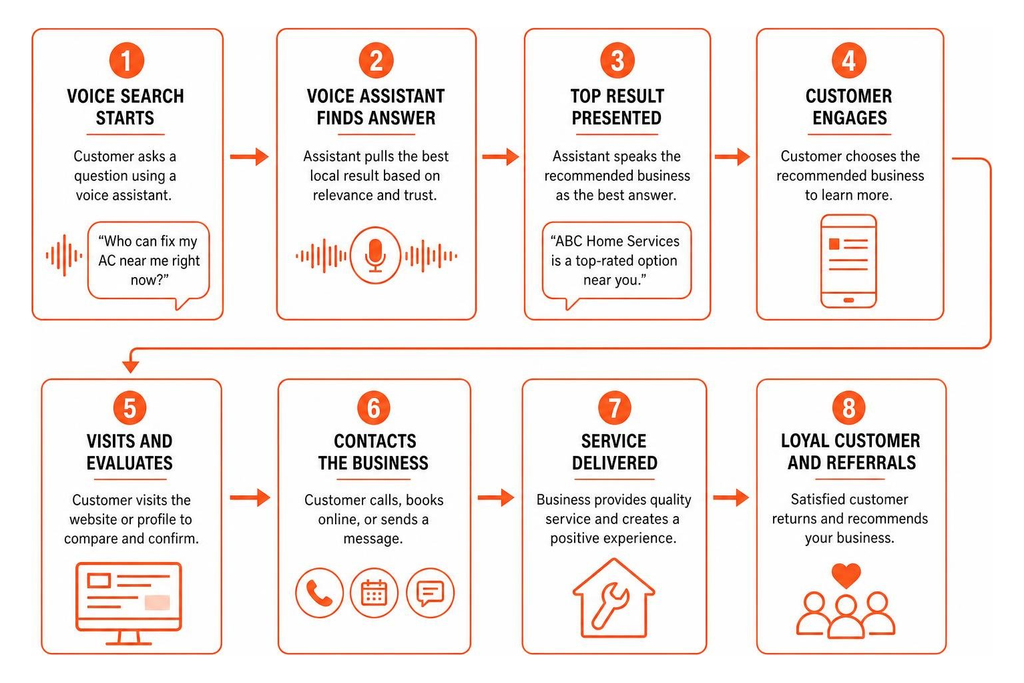
The digital landscape for home service companies is constantly evolving. As we look to September 2026, understanding customer behavior—especially in how they search for services—is paramount. The rise of voice search has fundamentally altered the customer conversion journey. No longer is it a linear path; instead, it’s a dynamic interaction often initiated by a spoken query, particularly in urgent situations like a burst pipe or a malfunctioning HVAC system. Our strategies must adapt to meet these conversational demands, ensuring our businesses are not just visible, but are the preferred answer when a voice assistant is asked for help. This means moving beyond simple keyword matching to a more holistic approach that anticipates user intent and provides comprehensive, easily digestible answers.
Core Pillars of Digital Marketing for Home Services
For any home service business aiming for sustained growth, a robust digital marketing foundation is essential. This foundation rests on several core pillars: strong local SEO, a meticulously optimized Google Business Profile (GBP), consistent Name, Address, Phone (NAP) information across all platforms, a well-structured and mobile-responsive website, and lightning-fast page speeds. These elements work in concert to ensure that when a potential customer searches for a service—whether by typing or speaking—our business appears prominently and provides an excellent user experience.

The local map pack, often the first set of results for “near me” queries, is a critical battleground for home service companies. Dominating this space requires a strategic approach that integrates technical optimization with a strong local presence.
Technical SEO and Website Speed Optimization
In the competitive home services market, your website’s technical health and speed are non-negotiable. Google’s algorithms, and by extension, voice assistants, favor sites that offer a seamless user experience. This begins with optimizing for Core Web Vitals, which measure loading performance, interactivity, and visual stability. A slow website frustrates users and can deter search engines from recommending your content. With mobile-first indexing, Google primarily uses the mobile version of your content for ranking, making mobile responsiveness crucial.
Furthermore, implementing local schema markup helps search engines understand specific details about your business, such as service areas, hours, and contact information. This is vital for voice search, as assistants often pull these direct answers. Ensuring HTTPS security protects user data and builds trust, while clean crawl paths allow search engine bots to efficiently discover and index your valuable content. These technical underpinnings are the silent workhorses that enable your content to be found.
Local Map Pack Dominance and Reputation Management
Beyond technicalities, our presence in the local map pack is heavily influenced by our online reputation. Google Reviews are arguably the most powerful signal of trust and quality for local businesses. Actively encouraging satisfied customers to leave reviews and promptly responding to all feedback—positive or negative—is crucial. Implementing efficient customer feedback systems can streamline this process.
Citation building, ensuring your business information is listed accurately and consistently across various online directories, reinforces your local authority. Proximity signals, which indicate how close your business is to the searcher, are naturally a factor in local search. However, review velocity—the frequency of new reviews—also plays a significant role, signaling an active and reputable business to both potential customers and search engines. Consistently managing these elements helps us not just appear in the local map pack, but dominate it.
Content Clustering and Conversational Search Architecture
As voice search continues its upward trajectory, the traditional keyword-centric approach to SEO is no longer sufficient. Instead, we must adopt a content clustering strategy, which organizes content around broad topics (pillar pages) supported by numerous, interconnected subtopic articles. This architecture demonstrates topical authority to search engines, signaling that our business is a comprehensive resource for specific home service needs.
Pillar pages delve deeply into a core service, like “HVAC System Maintenance,” while subtopic articles address specific questions or narrower aspects, such as “How Often Should I Change My Air Filter?” or “Benefits of Annual Furnace Tune-Ups.” These subtopic pages then link back to the pillar page, and to each other, forming a cohesive web of information. This semantic relevance is precisely what natural language processing (NLP) algorithms in voice assistants are designed to understand, allowing them to confidently extract answers from our content. For a deeper dive into how to leverage this strategy, consider exploring resources on data-driven digital marketing.
Aligning Voice Search with Digital Marketing for Home Services
Voice search queries are inherently conversational, longer, and often question-based. Users aren’t just typing “plumber Houston”; they’re asking, “Hey Google, who’s the best plumber in Houston for a leaky faucet?” or “Alexa, how do I stop a toilet from running?” Our content must be crafted to directly answer these conversational keywords and question-based intents. This means focusing on long-tail phrases that mirror natural speech patterns.
Optimizing for featured snippets is particularly critical for voice search. When a voice assistant provides an answer, it often pulls directly from Google’s “position zero” featured snippets. By structuring our content with clear, concise answers (ideally 40-60 words), using headings, bullet points, and a conversational tone, we increase our chances of being the source for these spoken responses.
Here’s a comparison of how search queries differ:
Typed Search Query (Traditional) Voice Search Query (Conversational) HVAC repair Houston Who can fix my AC in Houston right now? Water heater replacement cost How much does it cost to replace a water heater? Clogged drain DIY What’s the best way to unclog a kitchen sink? Electrician near me Hey Siri, find a licensed electrician close by. Furnace tune-up benefits Why should I get my furnace tuned up annually? Structured Data and Schema Markup Implementation
Structured data, often implemented using schema markup, acts as a translator for
and voice assistants, helping them understand the context and relationships within our content. For home service businesses, this is invaluable.
- FAQPage schema: Crucial for question-and-answer content, allowing voice assistants to directly pull answers to common queries.
- LocalBusiness markup: Provides essential information like business name, address, phone number, hours of operation, and service areas, which is vital for “near me” voice searches.
- HowTo structured data: Ideal for step-by-step guides, such as “How to reset your garbage disposal,” making your instructional content easily digestible by voice.
- Speakable attributes: This specific schema indicates which parts of an article are best suited for text-to-speech output, directly influencing how voice assistants read your content aloud.
- Entity-based SEO: By clearly defining entities (e.g., “HVAC system,” “plumber,” “Houston”) and their relationships within our content using schema, we enhance search engines’ understanding of our topical authority.
Implementing these schema types ensures that our content is not just readable by humans, but also perfectly understandable by the machines that power voice search.
High-Intent Paid Advertising and Multi-Channel Lead Generation
While organic strategies build long-term authority, high-intent paid advertising offers immediate visibility and lead generation, especially crucial for emergency home services. Google Local Services Ads (LSAs) are a prime example, placing our business directly at the top of search results for specific service queries, often with a “Google Screened” badge that instills immediate trust.
Pay-per-click (PPC) campaigns, carefully managed with geo-targeting, allow us to bid on high-value keywords within our service areas, ensuring we appear when customers are actively searching for solutions. A multi-channel approach ensures we capture leads from various touchpoints.
This integrated approach maximizes our reach and ensures we’re present wherever potential customers are looking.
Conversion Tactics in Digital Marketing for Home Services
Attracting leads is only half the battle; converting them into paying customers requires optimized conversion tactics. For home service businesses, immediacy and trust are key. Prominently displaying click-to-call buttons on our website and in ads allows customers to connect with us instantly, which is often preferred during an emergency. Direct online booking options cater to those who prefer scheduling at their convenience.
Transparency builds trust, and offering upfront pricing or clear service menus helps customers make informed decisions. Displaying trust badges (e.g., certifications, professional affiliations, “Google Screened”) and customer guarantees further reassures potential clients, turning inquiries into appointments.
Retargeting and Multi-Touch Social Campaigns
Not every lead converts on the first interaction. Retargeting and multi-touch social campaigns are essential for nurturing prospects and encouraging them to return. Brand recall is vital in a crowded market. By showing targeted ads to individuals who have previously visited our website or engaged with our social media, we keep our business top-of-mind.
Facebook local ads, for instance, can target users within specific geographic areas who have shown interest in home improvement. Email remarketing allows us to send personalized follow-ups, perhaps offering seasonal tune-up promotions or maintenance tips to past customers, fostering loyalty and repeat business. Customer lifecycle marketing ensures we’re engaging with clients at every stage, from initial inquiry to long-term maintenance contracts.
Performance Metrics and Analytics Tracking
To truly understand the effectiveness of our digital marketing efforts, we must meticulously track and analyze performance. This isn’t just about vanity metrics; it’s about understanding what drives real business growth. Attribution models help us understand which touchpoints in the customer journey contribute most to a conversion, allowing us to allocate our budget more effectively.
Call tracking software is indispensable for home service businesses, as phone calls are often the primary conversion point. This allows us to attribute calls to specific campaigns, keywords, or even voice search queries. Google Search Console provides invaluable insights into how our site performs in search, including which queries drive traffic and how we rank for featured snippets—critical for voice search. By monitoring our cost per lead (CPL) and customer acquisition cost (CAC), we can continuously refine our strategies to ensure profitability and sustainable growth.
A comprehensive analytics dashboard allows us to visualize these metrics and make data-driven decisions.
Frequently Asked Questions About Home Service Marketing
How quickly can a home service contractor see results from digital marketing?
The timeline for seeing results from digital marketing varies depending on the strategy. Paid search campaigns, like Google Local Services Ads and PPC, can generate leads almost immediately. Organic SEO, however, is a longer-term investment. While foundational changes might show initial improvements within weeks, significant shifts in local 3-pack ranking trajectory and sustained organic traffic typically enter a 3-6 month growth phase, requiring consistent effort.
Why is voice search optimization crucial for local contractors?
Voice search optimization is no longer optional but essential for local contractors in September 2026. The convenience of hands-free search means more people are using mobile voice queries, especially when dealing with emergency home repairs. With the widespread adoption of smart speakers, users expect immediate, spoken answers. Since voice assistants often provide a single, definitive result, being that answer gives us a massive competitive advantage.
What is the most cost-effective digital marketing channel for service businesses?
Defining the “most cost-effective” channel often depends on specific business goals and market conditions. However, an omnichannel mix generally yields the best results. For many home service businesses, Google Local Services Ads offer excellent ROI due to their high visibility and trust signals. Building a strong local SEO foundation, supported by robust customer review automation, provides a sustainable, long-term stream of cost-effective leads. The key is to find the right balance and continuously optimize based on performance data.
Conclusion
The digital marketing landscape for home service companies in September 2026 is dynamic. Driven significantly by the rise of voice search and advanced AI. By embracing content clustering and voice search optimization, we can strategically position our businesses to capture high-intent queries from customers. Who are increasingly speaking their needs into existence. This involves a commitment to technical excellence, local SEO dominance, conversational content, strategic paid advertising, and rigorous performance tracking. Through this strategic execution, we can ensure a sustainable lead flow. Forge a competitive advantage and solidify our market authority in an ever-evolving digital world.